Key Takeaways:
- PFOS was widely used for its grease, oil, water, and stain-resistant properties, including in food packaging applications.
- Regulations are moving beyond PFOS toward broader PFAS restrictions, with the EU and U.S. introducing measures affecting food-contact packaging.
- PFAS-free paperboard offers an alternative for food packaging, with solutions such as Foopak Bio Natura, Foopak Anchor Bio, and Foopak Grease Resistant Paper.
Per- and polyfluoroalkyl substances (PFAS) have long been used for their resistance to grease, oil, water, heat, and stains. One of the best-known substances in this group is perfluorooctane sulfonic acid, or PFOS.
PFOS itself has already undergone a major phase-out in many markets. In the United States, its primary manufacturer, 3M, began voluntarily phasing out PFOS production in 2000, with the phase-out completed by 2002. The U.S. Environmental Protection Agency (EPA) subsequently introduced restrictions on the manufacture and import of PFOS-related substances.
However, the regulatory discussion has since expanded beyond PFOS. Governments are increasingly addressing PFAS as a broader chemical group, including restrictions on PFAS used in food-contact packaging. This shift is particularly relevant for paper and paperboard packaging, where fluorinated chemicals were historically used to provide grease and oil resistance.
Why Was PFOS Widely Used in the First Place?
PFOS and other PFAS became widely used because of their ability to provide strong resistance to grease, oil, water, and stains. These properties made them useful in food packaging, where paper and paperboard need to prevent oils and liquids from penetrating the material.
In packaging, PFAS were particularly valued for:
- Grease and oil resistance to prevent fatty foods from soaking through paper
- Water resistance to help protect packaging from moisture
- Heat and chemical resistance for demanding food-contact applications
- Durability and performance without significantly changing the material’s appearance or feel
However, the persistence of PFOS and other PFAS in the environment raised concerns about their long-term impact. As a result, regulations have increasingly moved from restricting individual substances such as PFOS toward addressing PFAS as a broader chemical group.
Key Regulations Driving the PFOS Phase-Out
The transition away from PFOS is part of a much broader regulatory movement. Rather than focusing exclusively on one chemical, regulators are increasingly addressing PFAS more broadly, particularly when these substances are used in products that can come into direct contact with food.
1. European Union: PPWR and PFAS Restrictions
The European Union has taken a significant step through the Packaging and Packaging Waste Regulation (PPWR), Regulation (EU) 2025/40.
The PPWR applies from 12 August 2026 and introduces specific PFAS limits for food-contact packaging. From that date, food-contact packaging cannot be placed on the EU market if it contains PFAS at or above specified thresholds:
- 25 ppb for any PFAS measured through targeted PFAS analysis, excluding polymeric PFAS from quantification
- 250 ppb for the sum of targeted PFAS
- 50 ppm for PFAS including polymeric PFAS
The regulation is particularly relevant to paper and paperboard packaging because food-contact packaging is specifically within its scope.
The European Commission’s 2026 guidance also clarifies that food-contact packaging includes packaging intended to come into contact with food, meaning companies selling packaging into the EU need to consider PFAS compliance as part of their material and technical documentation requirements.
This represents an important shift in the packaging industry. Instead of simply checking whether a material contains a specific substance such as PFOS, manufacturers and converters increasingly need to understand the broader PFAS profile of their materials.
2. United States: State-Level PFAS Bans
The United States has taken a somewhat different regulatory path, with individual states introducing their own PFAS restrictions alongside federal actions.
The FDA announced in February 2024 that PFAS-containing grease-proofing substances were no longer being sold for food-contact use in the U.S. market. This effectively removed a major source of PFAS exposure associated with food packaging such as fast-food wrappers, microwave popcorn bags, take-out paperboard containers, and pet food bags.
In January 2025, the FDA also determined that 35 food-contact notifications covering PFAS-containing grease-proofers applied to paper and paperboard food packaging were no longer effective because these uses had been abandoned.
At the state level, restrictions have developed across multiple jurisdictions. Hawaii, for example, prohibits the manufacture, sale, distribution, or use of food packaging containing intentionally added PFAS, with its prohibition taking effect on December 31, 2024.
Minnesota similarly prohibits intentionally added PFAS in food packaging under its state law.
Other states, including California, Colorado, Maine, Maryland, New York, Oregon, Rhode Island, Vermont, and Washington, have also adopted PFAS restrictions or phase-outs affecting food packaging. The exact scope, definitions, exemptions, and effective dates differ by state.
For packaging manufacturers and brands operating across multiple U.S. markets, this means that PFAS compliance can no longer be treated as a single-market issue. Material specifications may need to account for different requirements depending on where packaging is sold or used.
3. Global Momentum Toward Broader PFAS Bans
The regulatory movement is also extending beyond PFOS and individual PFAS substances.
This distinction matters because PFOS is one member of the much larger PFAS family. Eliminating PFOS from a packaging material does not necessarily mean that the material is free from other PFAS.
The FDA’s food-contact guidance reflects this broader approach. It notes that PFAS are a large and diverse group of chemicals and explains that different PFAS can behave differently depending on their structure and application.
Meanwhile, regulations such as the EU PPWR establish limits covering PFAS as a broader category rather than simply prohibiting PFOS. This creates a stronger incentive for packaging manufacturers to move toward PFAS-free materials and alternative barrier technologies, rather than replacing one restricted fluorinated substance with another.
For packaging companies, the practical implications include:
- Reviewing raw materials, coatings, and functional additives for PFAS
- Requesting appropriate PFAS documentation and test reports from suppliers
- Considering destination-market requirements during material selection
- Developing grease- and moisture-resistant alternatives that do not depend on fluorinated chemistry
- Maintaining technical documentation to demonstrate compliance where required
For foodservice packaging in particular, PFAS-free design is becoming increasingly important as regulations converge around safer food-contact materials.
Foopak Paperboard Solutions for PFAS-Free Packaging
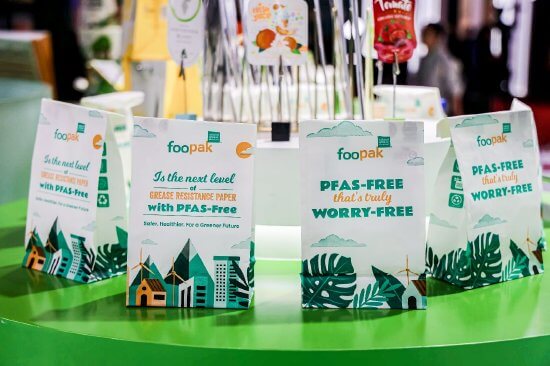
The shift away from PFOS and other PFAS is encouraging packaging manufacturers to explore alternative barrier technologies that can provide grease and moisture resistance without relying on fluorinated chemicals.
Foopak offers PFAS-free paper and paperboard solutions for food packaging applications. Foopak Bio Natura, for example, uses aqueous dispersion coating technology to provide grease and moisture resistance while remaining PFAS-free. It is designed for applications such as cups, bowls, food containers, and lunch boxes.
For other applications, Foopak Anchor Bio provides moisture protection and edge-wicking resistance, while Foopak Grease Resistant Paper is designed for packaging that requires grease and oil resistance. These solutions give packaging manufacturers alternatives as regulations around PFAS continue to evolve.
FAQ
1. Are PFOS and PFAS the same?
No. PFAS refers to a large family of thousands of synthetic chemicals, while PFOS (perfluorooctane sulfonic acid) is one specific type of PFAS. PFOS is among the most extensively studied PFAS and has been phased out of production in the U.S.
2. What products contain PFOS?
PFOS has historically been used in products requiring oil, water, grease, or stain resistance. Potential sources have included some food packaging, stain-resistant carpets and fabrics, water-resistant clothing, firefighting foams, and certain industrial products. Because PFOS has been phased out or restricted in many markets, its presence in current consumer products is generally much lower than in the past.
3. What does PFOS do to humans?
PFOS can remain in the body for extended periods, and research has found associations between PFOS exposure and increased cholesterol, changes in liver enzymes, lower antibody response to some vaccines, small decreases in birth weight, and pregnancy-induced hypertension or preeclampsia. However, health outcomes depend on factors such as exposure level, frequency, duration, and individual characteristics, and research on PFAS health effects is still ongoing.