Key Takeaways:
- FBB is a versatile paperboard for folding cartons, offering a balance of stiffness, bulk, lightweight construction and printability.
- Different paperboard types suit different packaging needs, with FBB, SBS, recycled paperboard and kraft paperboard differing in their fiber composition, appearance and performance.
- Foopak Hard Size Board is designed for food packaging applications, offering high stiffness, dimensional stability and printability for applications such as cake, chocolate and confectionery packaging.
Choosing the right paperboard is an important part of developing effective packaging. Different paperboard types offer different combinations of stiffness, printability, appearance, weight, sustainability and cost, so the best choice depends on the packaging application and its performance requirements.
Among the commonly used options, Folding Box Board (FBB) is known for its balance of strength, lightweight construction and printability. But how does it compare with other paperboard types such as Solid Bleached Sulfate (SBS), recycled paperboard and kraft paperboard?
What Type of Paper is FBB?
Folding Box Board (FBB) is a multilayer paperboard designed primarily for folding carton applications. Compared with paper, paperboard is thicker and more rigid, providing the structural support needed for packaging.
FBB is generally designed to combine high stiffness, bulk and relatively low weight, making it suitable for folding cartons that need to maintain their shape while remaining efficient to handle and transport. Its smooth, printable surface also makes it suitable for packaging that requires high-quality graphics and strong visual appeal.
These characteristics make FBB particularly useful for food packaging, where the board needs to provide both structural performance and a suitable surface for printing and branding. Depending on the grade, FBB can be used for applications ranging from confectionery and bakery packaging to other folding cartons.
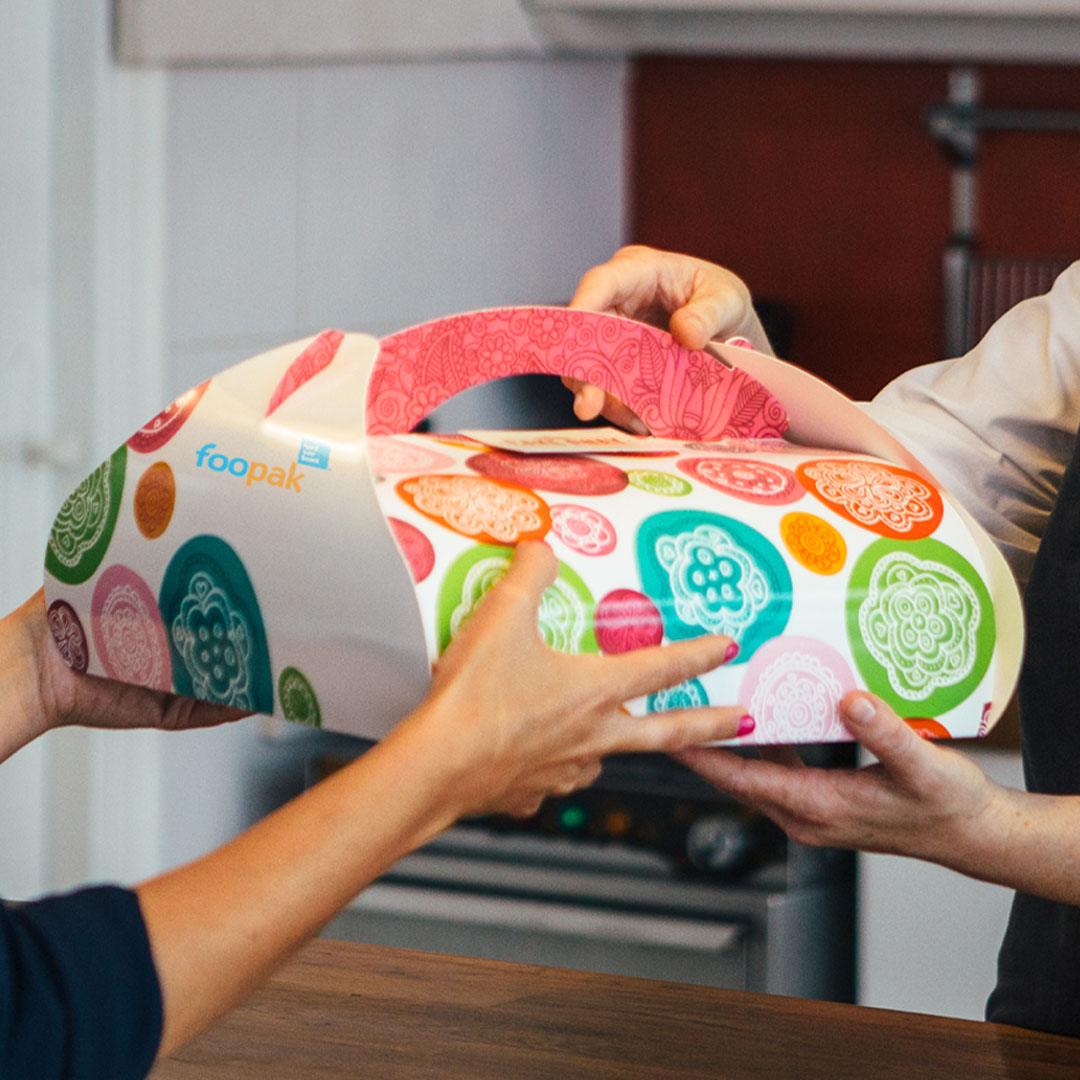
For food packaging applications that require additional rigidity and stability, Foopak offers Foopak Hard Size Board. This high-bulk folding box paperboard is made from virgin fibers sourced from PEFC-certified wood and is designed to maintain its strength and shape, including in chilled or cold-storage conditions. It also features a smooth, printable surface for high-quality graphics.
Read More: Meet Foopak Greaseproof Board: The Barrier Paperboard that Holds Up to Grease and Heat
What is Folding Box Board Used For?

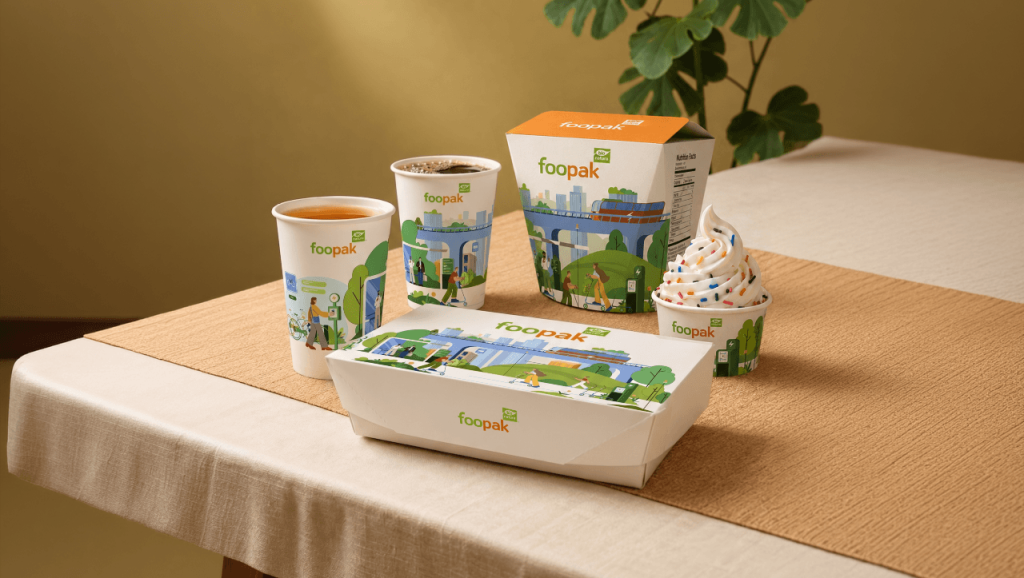
FBB is commonly used for folding cartons where packaging needs to be lightweight while maintaining sufficient stiffness and structural integrity.
Typical applications of FBB include:
- Food packaging, such as folding cartons for confectionery, bakery products, snacks and other packaged foods
- Foodservice packaging, including takeaway boxes, dessert boxes and other food containers
- Chocolate and confectionery packaging, where stiffness and high-quality printing help protect the product and enhance presentation
- Cold and chilled food packaging, where the board needs to maintain its strength and shape under low-temperature conditions
- Pharmaceutical packaging, where dimensional stability, printability and reliable folding performance are important
- Cosmetics and personal care packaging, where appearance and high-quality graphics are key considerations
- Retail and consumer packaging, including cartons for a range of everyday products
FBB can also support material efficiency. Its lightweight construction can reduce the amount of raw material required for a package and lower transport weight, although the overall environmental impact depends on the specific board, manufacturing process, coatings and end-of-life system.
Read More: The Challenges of Lightweight Packaging and How to Get It Right
Where is FBB Popular?
For FBB, recent market research shows that Asia-Pacific is a particularly strong market, with FBB accounting for 53.78% of the region’s folding-carton market in 2025, according to Mordor Intelligence’s report published in May 2026. The report identifies China as the largest country market, accounting for 46.63% of Asia-Pacific’s folding-carton market in 2025, while India is projected to be the fastest-growing major market, at a CAGR of 10.15% through 2031.
Understanding the Differences Between Folding Box Board and Other Paperboard Types
FBB is not automatically the best choice for every packaging application. SBS, recycled paperboard and kraft paperboard each have characteristics that may make them more suitable depending on the product, design and performance requirements.
Differences Between FBB and SBS
SBS stands for Solid Bleached Sulfate. It is generally made from bleached virgin chemical pulp throughout the board, whereas FBB uses a multilayer structure combining chemical pulp with a high-yield middle layer.
The difference in construction affects how each board performs.
FBB is often selected when lightweighting, stiffness and material efficiency are important. Its multilayer structure provides high bulk and stiffness while maintaining a printable surface.
SBS, meanwhile, is known for its bright, uniform white appearance and high-quality printing surface. It is often preferred for premium packaging where color reproduction, surface appearance and a clean white interior are particularly important.
In simple terms:
- Choose FBB when stiffness-to-weight performance and material efficiency are priorities.
- Choose SBS when premium whiteness, print quality and a uniform white appearance are especially important.
The choice ultimately depends on the product and packaging requirements rather than simply which board is considered higher quality.
Differences Between FBB and Recycled Paperboard
Recycled paperboard is made using recovered paper fibers, although the exact composition can vary between grades. Coated recycled board (CRB), for example, is commonly used for folding cartons and other packaging where recycled content and cost efficiency are important.
Compared with recycled paperboard, FBB is commonly associated with virgin-fiber construction and a multilayer structure designed to achieve a high stiffness-to-weight ratio. This can make it suitable for packaging where structural performance, printability and a clean appearance are important.
Recycled paperboard can be an attractive option when recycled content is a major consideration, particularly for applications where the appearance and performance requirements can accommodate the characteristics of recovered fibers.
The key difference is therefore not simply whether one material is “better” for sustainability. Factors such as fiber sourcing, manufacturing, coatings, transportation and the availability of recycling infrastructure all contribute to a packaging material’s overall environmental profile.
Differences Between FBB and Kraft Paperboard
Kraft paperboard is valued for its strength and is commonly used for packaging applications that require structural durability. Unbleached kraft grades can also provide a distinctive natural appearance that supports brands looking for a more rustic or natural packaging aesthetic.
FBB generally offers a different balance. Its layered construction and bleached outer surfaces can provide high stiffness with relatively low weight, along with a surface suitable for detailed graphics and branding.
Kraft paperboard may therefore be a better fit when:
- High structural strength is a priority
- A natural or kraft appearance suits the brand
- The package needs to handle heavier products or demanding applications
FBB may be preferable when:
- Lightweighting is important
- The package requires good folding and stiffness
- High-quality graphics are an important part of the design
- A clean, bright printable surface is desired
Ultimately, board selection should consider the complete packaging system, including product weight, carton design, printing process, converting requirements, storage conditions and end-of-life considerations.
Table Comparison of FBB and Other Paperboard Types
| Feature | FBB | SBS | Recycled Paperboard | Kraft Paperboard |
| Fiber composition | Virgin fiber, multilayer construction | Virgin bleached chemical pulp | Recovered/recycled fibers | Primarily virgin kraft fiber |
| Stiffness | High stiffness-to-weight ratio | High | Moderate to high, depending on grade | High |
| Weight efficiency | Excellent | Good | Varies | Good |
| Printability | Excellent | Excellent | Good, depending on grade | Good |
| Surface appearance | Bright, smooth and printable | Very bright, smooth and uniform | Generally less uniform | Natural brown or bleached appearance |
| Folding performance | Excellent | Excellent | Good | Good |
| Typical applications | Folding cartons, food, confectionery, cosmetics, pharmaceuticals | Premium folding cartons, cosmetics, food, pharmaceuticals | Folding cartons, dry food and consumer packaging | Heavy-duty packaging, food packaging and retail cartons |
| Key advantage | Balance of stiffness, lightweighting and printability | Premium appearance and print quality | Recycled content and material efficiency | Strength and natural appearance |
Explore FBB Solutions with Foopak
Paperboard should balance packaging performance with food safety, brand presentation and sustainability goals. Foopak offers paper and paperboard solutions designed for food and beverage packaging, with products developed around performance, food safety and responsible sourcing.
For folding carton applications, Foopak Hard Size Board is a high-bulk folding box paperboard made from virgin fibers sourced from PEFC-certified wood. It is designed to provide rigidity, dimensional stability and strong printability, including for applications such as cake boxes, tart boxes, chocolate packaging, pharmaceuticals and confectionery.
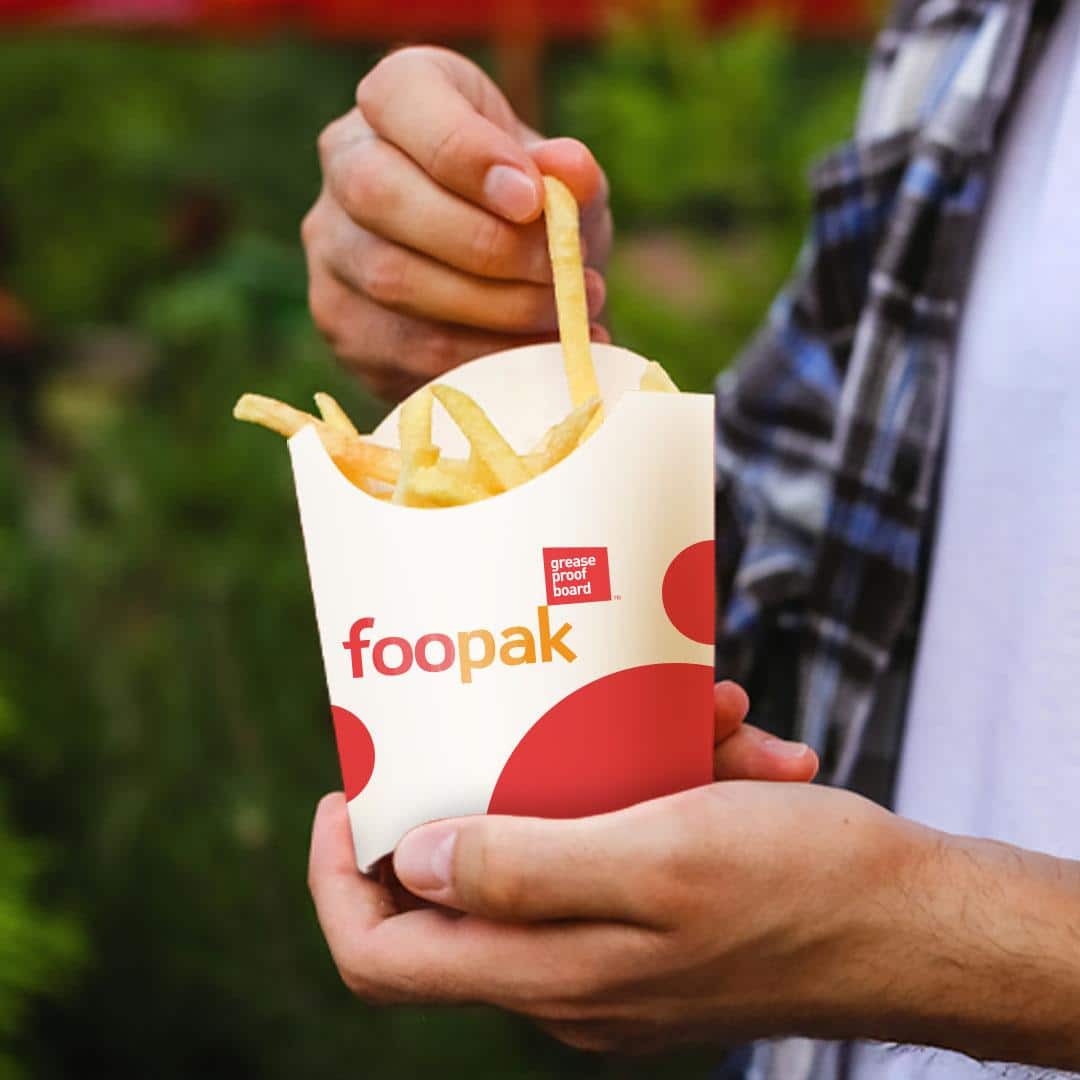
Foopak also offers Foopak Greaseproof Board, a folding box paperboard designed with oil and grease resistance for food packaging applications. It is PFAS-free and available in different grease-resistance levels to accommodate varying packaging requirements.
Find the right paper and paperboard solution for your food packaging with Foopak today.
FAQ
1. What are foldable boxes called?
Foldable boxes are commonly called folding cartons or folding boxes. They are typically made from paperboard such as FBB and are designed to be folded and assembled into a rigid package.
2. What are the four different types of paperboard?
Four commonly used types of paperboard are Folding Box Board (FBB), Solid Bleached Sulfate (SBS), recycled paperboard and kraft paperboard. Each has different characteristics in terms of fiber composition, strength, appearance, printability and typical applications.
3. Is paperboard the same as cardboard?
No. Although the terms are sometimes used interchangeably, paperboard and cardboard are not technically the same. Paperboard is generally a single-layer or multilayer paper-based material used for packaging and other applications, while cardboard is a broader term that can refer to thicker paper-based materials, including corrugated board.