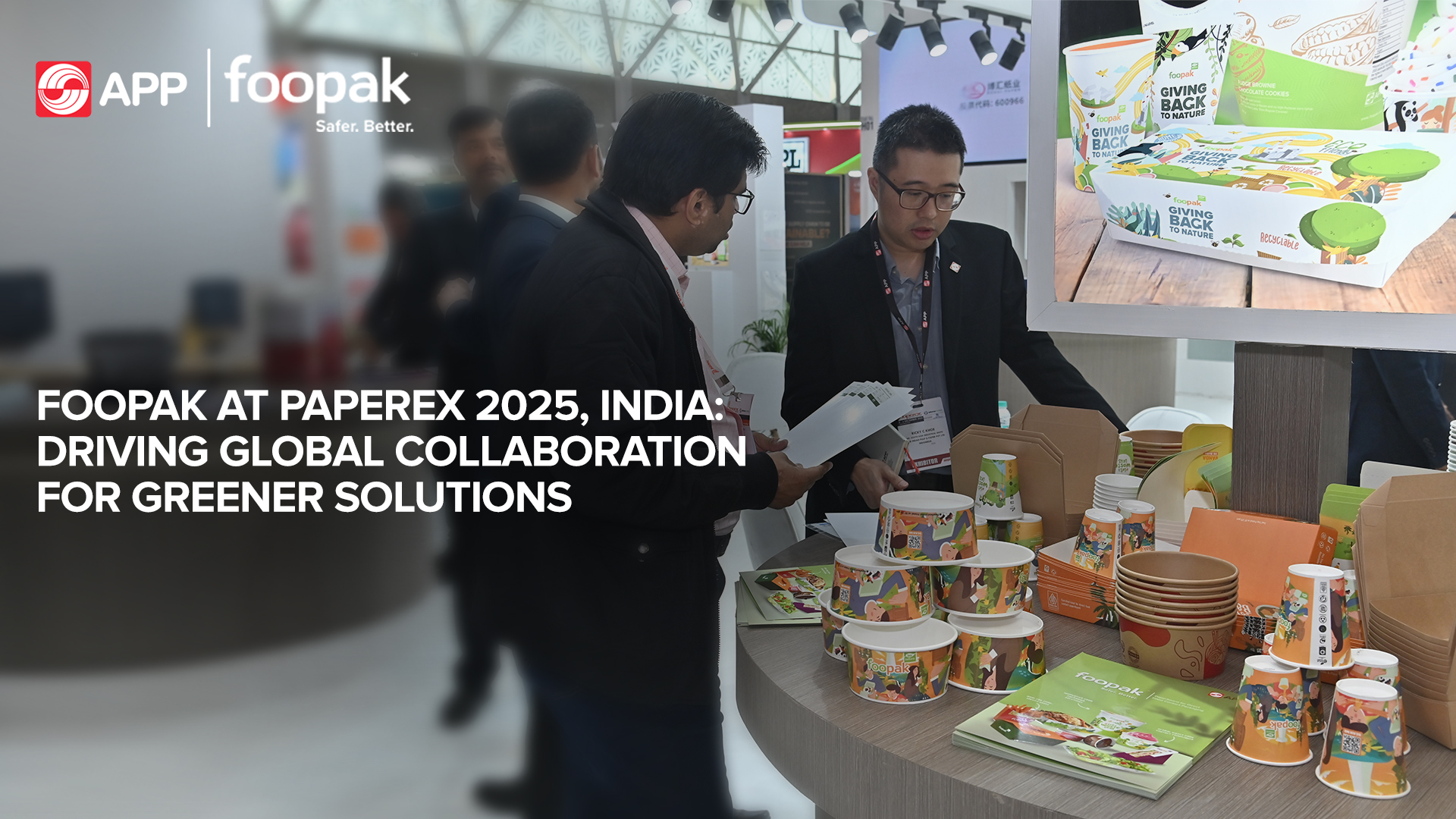
Foopak showcased its latest sustainable packaging solutions at Paperex 2025, one of the world’s largest international exhibitions for the paper, pulp, and packaging industry. The event took place from December 11-14, 2025, at the India Expo Centre, Greater Noida, Delhi-NCR, India.
A Look Back into Foopak’s Presence and Key Moments at Paperex 2025
Foopak, a paperboard brand under APP Group, continues to expand its global footprint by promoting responsible production and sustainable materials. Through ongoing research and development, Foopak delivers paperboard solutions that are biodegradable, recyclable, and PFAS-free, supporting businesses seeking to reduce their environmental footprint.
From Asia To The World: Foopak Is Driving The Shift To Sustainable Packaging

At Paperex 2025, Foopak participated alongside APP China and APP Indonesia, which included the Industrial White BU (covering Foopak) and the Cultural BU. The shared booth welcomed visitors at Stand No. H01, Hall No. 1, where the teams showcased paperboard packaging for food, beverage, and consumer goods applications.
Throughout the exhibition, discussions with customers and partners centered on market needs, material innovation, and the growing shift toward sustainable packaging. Visitors also had the chance to see firsthand how Foopak’s paperboard products support brands aiming to reduce waste and meet evolving regulatory expectations.
Connecting With Industry Partners at Post-Paperex Customer Engagement Event

After the exhibition, APP Group hosted a separate customer gathering in New Delhi. Held on Thursday, 4 December 2025, at Roseate House, this Night Cocktail & Dinner event was organized outside the Paperex schedule as a dedicated opportunity to connect and extend appreciation to customers from across India and abroad.

Atul Tyagi, Export Sales Head of the Industrial White BU at APP Group, delivered a presentation during the APP Group customer gathering in India
During the gathering, Atul Tyagi, Export Sales Head of the Industrial White BU at APP Group, shared:
“Our goal is not just to offer sustainable paperboard, but to help brands transition away from plastic with solutions that align with quality, safety, and performance expectations. The positive response we received here confirms that demand for green packaging is growing rapidly, especially in markets like India.”
Market Demand in India & Asia

The growing demand for eco-friendly food and beverage packaging in India and other Asian countries highlights a major shift among brands and consumers toward sustainability and safety.
- In India, the paper-packaging market reached around US$ 19.07 billion by August 2025 and is projected to reach about US$ 46.43 billion by 2030.
- The India paper-packaging market size was estimated at US$ 18.6 billion in 2024, with a forecasted CAGR of 4.56% for 2025-2033.
- In the Asia-Pacific region, paper & paperboard packaging demand accounts for approximately 27% of global demand, and over 49% of that regional demand is used in food & beverage applications.
Prior Exhibitions & Regional Expansions
Over the past few years, Foopak has actively participated in international trade fairs such as FACHPACK in Germany, Expo Pack in Mexico, and Propak Asia in Thailand. These exhibitions have strengthened Foopak’s global recognition as a trusted provider of high-performance and sustainable paperboard.
Following strong growth across Southeast Asia, Europe, and Latin America, Foopak now looks to expand further into South Asia, particularly in India, one of the fastest-growing markets for sustainable packaging.
Partner with Foopak for Sustainable Growth
Foopak welcomed like-minded organizations, such as brand owners, converters, and industry professionals, to explore collaboration opportunities at Paperex 2025. As businesses seek sustainable packaging solutions, Foopak offers advanced paperboard products supported by APP Group’s world-class manufacturing and sustainability practices.
Together, we can drive the transition toward a more sustainable future, one where packaging not only protects products but also protects the planet.